

Guide
On-Demand vs. Stock Production: A Merchandising Comparison
When to choose on-demand production and when to opt for stock-keeping – a comparison of costs, delivery times and risk.

Choosing the right production and logistics model is one of the key strategic decisions for any successful merchandising programme. Whether for companies, universities or brands, the choice between on-demand production and traditional stock production has far-reaching consequences for costs, delivery times, product quality and business risk. Both approaches have their own merits and specific advantages. This guide provides an objective comparison of the models to help you find the right strategy for your goals.
What is On-Demand Merchandising?
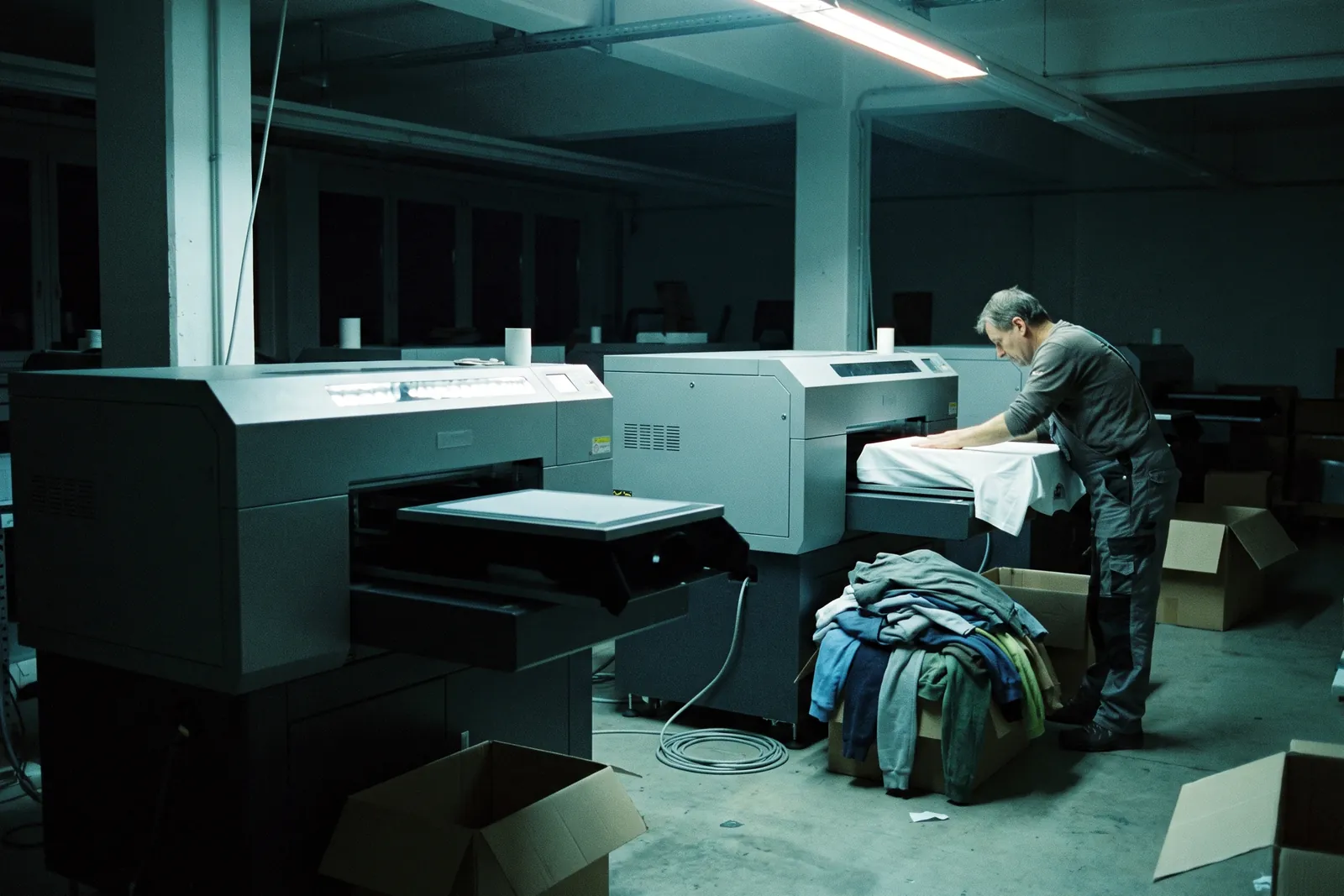
On-demand merchandising, often referred to as Print-on-Demand (PoD), is a production model where a product is only manufactured once an order has been received. Instead of producing and storing a large batch of T-shirts, mugs or bags in advance, each individual item is made to order and shipped directly to the end customer. This process is typically automated through software integration between a webshop and a specialised production service provider.
- Advantage: No stock risk and no upfront investment in goods.
- Disadvantage: Higher unit costs and longer delivery times.
The Classic: Stock Production (Bulk Production)
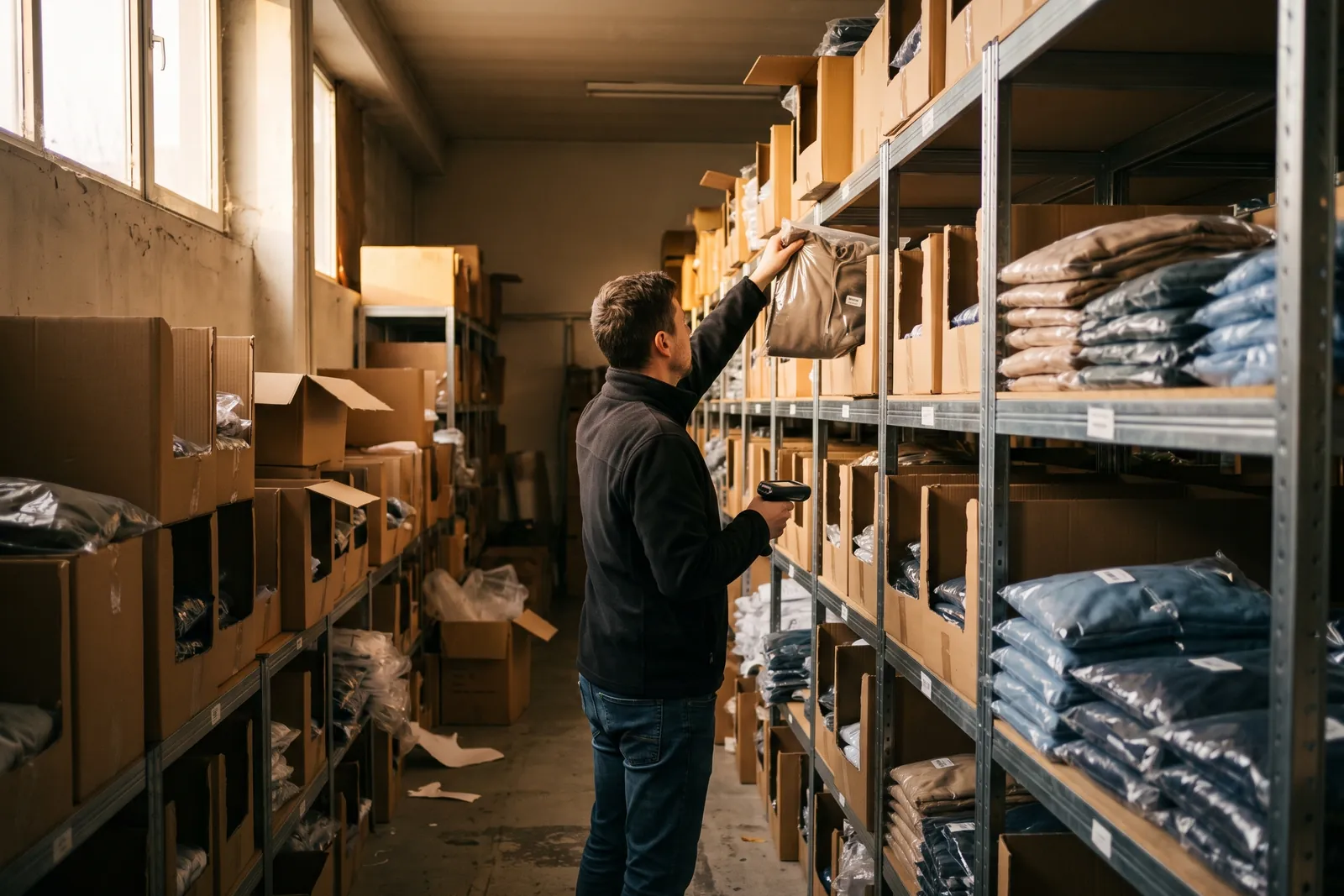
With stock production, a defined quantity of an item – the production run – is manufactured in a single batch. These goods are then stored in a warehouse and, upon receipt of an order, are picked, packed and dispatched. This model benefits from economies of scale in production: the larger the production run, the lower the cost per unit typically is.
- Advantage: Lower unit costs, fast delivery capability and full control over product quality.
- Disadvantage: High capital commitment and the risk of being left with unsold stock.
A Direct Comparison of the Models: Key Factors for Your Decision
To make the right choice, you should weigh the following aspects against each other and relate them to your specific project.
Costs and Margin
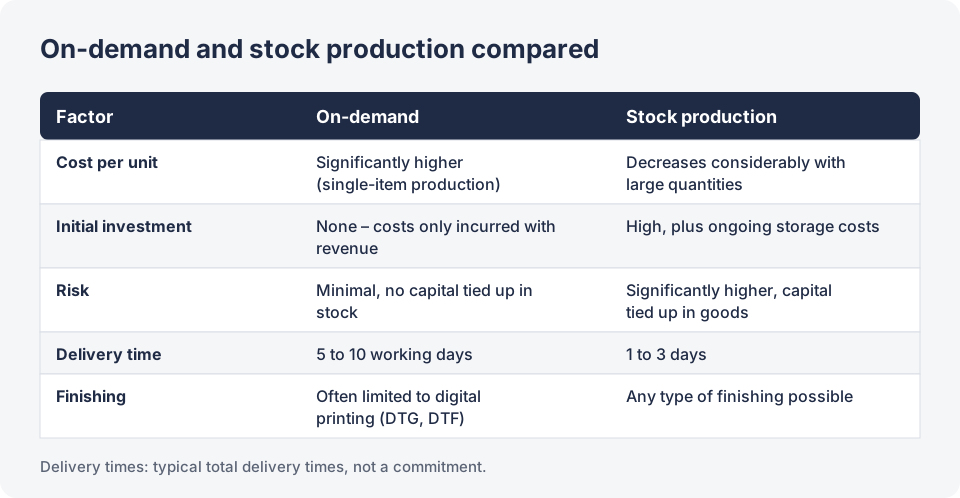
On-Demand: The production cost per item is significantly higher, as it is a single-item production. The profit margin per product sold is therefore usually lower. However, the key advantage is that no initial investment is required. Costs are only incurred when revenue is generated.
Stock Production: By purchasing large quantities, the cost price per unit decreases considerably. This allows for a higher margin per item sold, provided that the produced goods are actually sold. This is offset by the high initial investment costs for the entire production run, as well as ongoing storage costs.
Risk and Capital Commitment
On-Demand: The financial risk is minimal. Since no goods are pre-produced, there is no capital tied up in stock. You can offer countless designs and product variations without worrying about accumulating slow-moving items. This makes the model ideal for testing new designs or products.
Stock Production: The risk is significantly higher. You tie up capital in goods whose sales success is not guaranteed. A misjudgement of demand can lead to large amounts of residual stock that can only be sold at a heavy discount, or not at all.
Delivery Times and Customer Experience
On-Demand: Delivery times are naturally longer, as production time (usually several working days) is added to the standard shipping time. A total delivery time of 5 to 10 working days is not uncommon. This must be clearly communicated in the shop to manage customer expectations.
Stock Production: This is one of the biggest advantages. Since the goods are on the shelf ready for dispatch, an order can often be sent out the same or the next day. Short delivery times of 1 to 3 days are a key factor in customer satisfaction.
Product Variety and Finishing Options
On-Demand: The strength here lies in the almost unlimited variety. You can offer hundreds of designs on dozens of products without investing a penny. However, the finishing options are often technically limited to digital printing (DTG, DTF). Complex embroidery, special colours, custom placements or the inclusion of your own neck labels are usually not possible.
Stock Production: You have full control over the final product. Any type of finishing is possible – from high-quality screen printing and complex embroidery programmes to custom hangtags or packaging. You can check and approve the quality based on a production sample before the main run begins. This is crucial for building consistent brand quality.
A note on differentiation: If you simply need to have a smaller batch of textiles (from 10 pieces) printed or embroidered and want to choose the appropriate finishing technique yourself, our specialised service at unicum-textildruck.de is the right place for you.
Which Model Suits Whom? A Decision-Making Guide
- On-demand merchandise is particularly suitable for:
- Start-ups and projects with a limited budget.
- Testing new designs and product ideas without financial risk.
- Niche markets with very broad but difficult-to-forecast demand.
- Influencers or clubs who want to offer a wide variety of designs.
- Stock production is the first choice for:
- Established brands and companies with bestselling items and predictable sales figures.
- Corporate merchandising programmes where quick availability and guaranteed, consistent quality (e.g., for staff uniforms or events) are crucial.
- Collections that demand high product quality and special finishes (e.g., textiles made from GOTS-certified organic cotton or products made from recycled polyester).
- Maximising the profit margin on popular products.
The Hybrid Solution: The Best of Both Worlds
An increasingly popular strategy is to combine both models. Core products and bestsellers with high demand are produced for stock to ensure fast delivery times and a high margin. At the same time, the product range is expanded with a selection of on-demand items. This allows new designs to be tested risk-free, seasonal promotions to be implemented, or a wider variety of products to be offered. However, this approach requires sophisticated logistics and system integration.
Managing such a hybrid model, setting up the processes and choosing the right partners are crucial for success. A professional service provider can not only supply the right webshop but also handle the entire fulfilment process, including storage, on-demand integration and dispatch. This allows you to focus fully on your brand and your products.
Looking for full-service merchandising?
We handle your promotional product projects from A to Z – from a single source.
To Full-Service