

Guide
OCI Integration Explained: Merchandising in Your Procurement System
What OCI and Punchout mean – and how a merchandising shop can be integrated directly into SAP and other systems.

Large companies and organisations often face a challenge when procuring merchandising items: How can employees from different departments or locations access a central product range easily and in compliance with company rules? The process needs to be efficient, adhere to the corporate design, and integrate seamlessly into existing approval workflows. The solution often lies in the technical integration of the supplier's shop into the company's own procurement system. A key technology for this is the OCI integration (Open Catalog Interface).
What exactly is an OCI integration?
The Open Catalog Interface, or OCI for short, is a standardised interface developed by SAP. It enables a direct connection between a company's enterprise resource planning (ERP) or procurement system and a supplier's external webshop. The technical process where a user accesses the external catalogue from within their own system is known as a “Punchout”. OCI is therefore the standard that technically defines this Punchout process and ensures it runs smoothly.
At its core, it's about automating and centralising the ordering process. Instead of employees manually creating items in their ERP system or ordering through non-integrated channels, they jump directly from their familiar system environment to the approved merchandising catalogue, assemble their shopping basket, and then transfer it back to their own system for further processing. This works with common e-procurement solutions like SAP Ariba, Coupa, or Oracle.

The Punchout process in practice: A step-by-step guide
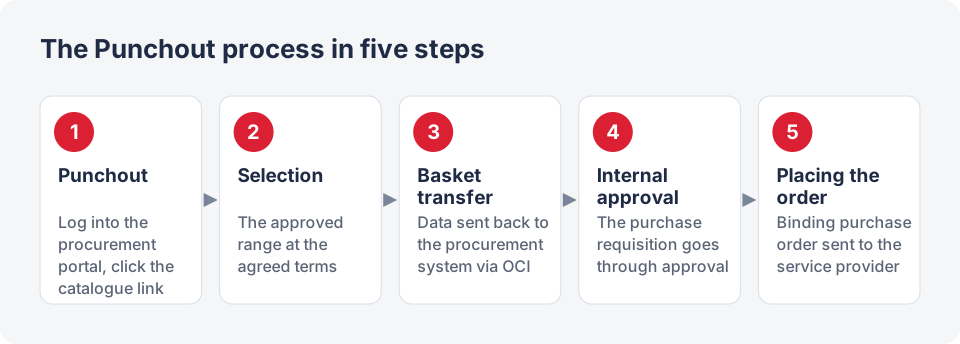
For the person placing the order, a typical procurement process via an OCI interface is very straightforward. The complex data exchange happens in the background and follows a clear pattern:
- 1. Punchout: An authorised employee logs into their company's internal procurement portal. From there, they click on the link to the merchandising catalogue. The system automatically authenticates them with the supplier.
- 2. Item selection in the external shop: The employee is now in the service provider's merchandising webshop. However, they only see the product range approved for their company at the agreed conditions. They can browse products, view details, and add items to their shopping basket, just like in a normal online shop.
- 3. Shopping basket transfer: Instead of completing the purchase in the external shop, the employee clicks a button such as “Transfer basket” or “Send order to ERP”. The shopping basket is not ordered at this stage; instead, its data is sent back to the company's procurement system via the OCI interface.
- 4. Internal approval: The transferred shopping basket appears in the ERP system as a purchase requisition. It now goes through the standard internal company approval process (e.g., sign-off by a line manager or cost centre manager).
- 5. Placing the order: Only after final internal approval is a binding purchase order generated and sent electronically to the merchandising service provider.
The key benefits for your company
Implementing an OCI integration for merchandising needs offers significant advantages, especially for larger organisations with decentralised structures and strict compliance requirements.
Efficiency and process optimisation
Manual data entry is eliminated, which drastically reduces the error rate. The entire process, from searching for an item to getting approval, is accelerated as there are no more media breaks. Procurement departments are relieved of their workload, as employees can meet their own needs independently within the predefined framework.
Compliance and cost control
The OCI integration ensures that only approved products are ordered from listed suppliers at pre-negotiated prices. Adherence to corporate design guidelines is guaranteed. Since every order must go through the internal approval workflow, the company retains full control over spending.
Up-to-date information and user-friendliness
Employees always access the supplier's live, updated catalogue. Product information, images, and stock levels are always current. Furthermore, the intuitive and visually appealing interface of a modern webshop is significantly more user-friendly than the often rigid input screens of an ERP system.

When does setting up an OCI interface make sense?
An OCI integration is not the right solution for every use case. It reaches its full potential primarily in organisations that regularly procure merchandising or promotional items and already use a professional e-procurement system. If many different departments or branches are placing orders, the interface provides the necessary structure and control.
For one-off orders, smaller quantities, or when the focus is on the individual selection of finishing techniques like printing or embroidery, a direct ordering route is often more practical. For such requirements, like printing on textiles from 10 pieces upwards, we recommend our specialised service at unicum-textildruck.de.
In contrast, integrating a merchandising shop via OCI is ideal for procuring a fixed product range – from organic cotton T-shirts and notebooks to power banks made from recycled plastic – in a standardised way across the company. The logistics, including warehousing and shipping, can also be managed centrally by the service provider.
The successful implementation of an OCI integration is a key component of a well-thought-out merchandising strategy. As a partner for full-service promotional materials, we support companies in planning and implementing such projects – from product range design and technical integration to complete logistical handling.
Looking for full-service merchandising?
We handle your promotional product projects from A to Z – from a single source.
To Full-Service