

Guide
Introducing School Clothing: A 7-Step Guide for Schools
Do you want to introduce school clothing at your school? From the initial idea to parent involvement and setting up your own school shop – here's how to succeed with the project, step by step.

The introduction of school clothing is a strategic project that goes far beyond simply choosing a T-shirt. In contrast to the often-discussed school uniform, voluntary school clothing is based on identification and acceptance. It consists of a curated collection – for example, hoodies, polo shirts, and T-shirts with the school logo – that pupils and teachers enjoy wearing. Such a programme strengthens community spirit, reduces social pressure from branded clothing, and ensures a unified appearance at events. A well-thought-out concept is key to success. This guide will lead you, whether you are a school management, a PTA, or a dedicated parent representative, through the entire process in seven practical steps, from the initial idea to the operational school shop.
Step 1: Define Project Goals – The Foundation of Success
Before you select designs or textiles, the fundamental goals of the project must be clearly defined. These goals form the basis for all further decisions and help to argue the concept to committees, parents, and the student body. Sit down with the relevant stakeholders and clarify what you primarily want to achieve with the introduction of school clothing.
Possible objectives include:
- Strengthening identification and community spirit: A common logo and design create a visible sign of belonging to the school community.
- Reducing social pressure and brand fetishism: Uniform clothing can shift the focus away from expensive branded goods, thus contributing to a more socially relaxed school atmosphere.
- Improving external perception: For excursions, sports events, or open days, school clothing ensures a professional and recognisable appearance.
- Increasing safety: On trips, pupils in uniform clothing are easier for teachers to identify.
Document these goals. They serve as guidelines for the collection's design, pricing, and project communication.
Step 2: Involve All Stakeholders – Build Acceptance
A school clothing project can only be successful if it is supported by a broad majority of the school community. In Germany, wearing school clothing is generally voluntary. Therefore, involving all relevant groups from the outset is essential to ensure acceptance and avoid resistance.
Important Committees and Groups:
- School Management: Bears the final responsibility and must support the project.
- School Conference: The school's highest committee, where teachers, parents, and pupils are represented. A formal resolution by the school conference lends legitimacy to the project.
- Parent Representation (Parent Council): An important multiplier for informing parents and addressing their concerns.
- Student Representation (SV): Direct involvement of pupils is crucial. They are the target group and can provide valuable input on design and assortment.
- PTA: Often plays a central role in organisation and potential co-financing.
Organise information events, launch surveys on design preferences, and openly discuss the endeavour in the committees. Transparency regarding goals, costs, and the organisational process is the most important factor here.
Step 3: Develop the Collection and Design
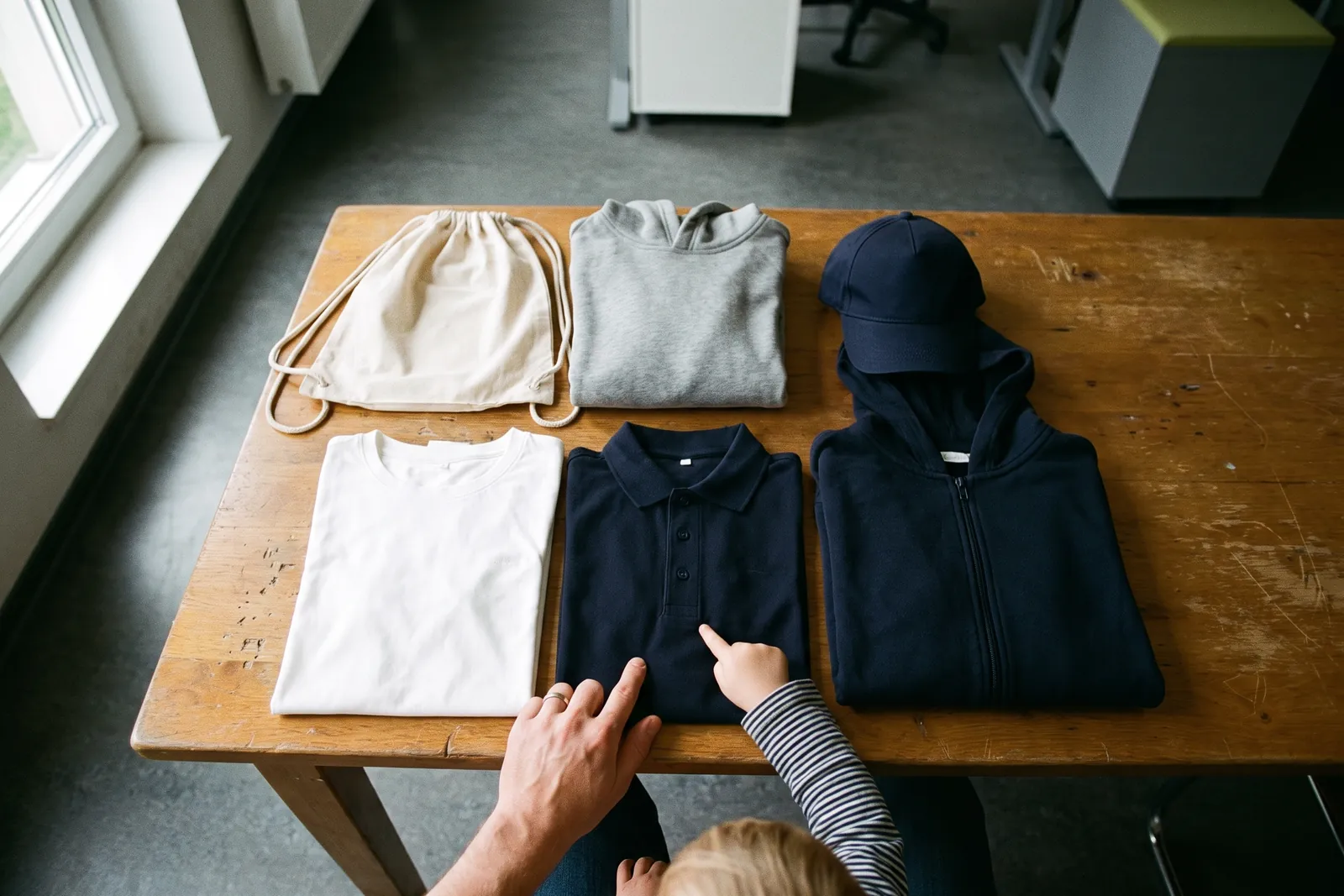
Less is often more. A manageable yet easily combinable core collection has proven effective in practice. It ensures that items are versatile and keeps organisational effort low. Focus on proven classics in school colours or neutral tones such as navy, grey, or white.
A typical basic assortment includes:
- T-shirt (unisex and, if applicable, fitted cuts)
- Polo shirt
- Sweatshirt or hoodie
- Zip-up hoodie (hooded sweatshirt jacket)
- Optional: Sports bag, beanie, or baseball cap
When selecting products, quality and production conditions should be paramount. We offer a wide selection of textiles, including numerous items made from organic cotton or with certifications such as GOTS or Fair Wear. The school logo or a specially developed motif is then applied through a high-quality finishing by printing or embroidery, which withstands frequent washing.
Step 4: Determine the Funding Model and Pricing
Funding is a sensitive point. Prices must be set so that as many families as possible can afford the school clothing. Pre-financing by the school or the PTA involves significant effort and financial risk (e.g., due to leftover stock in unpopular sizes). An on-demand model via an online shop completely bypasses this problem.
Important pricing considerations:
- No profit motive: School clothing should not be a commercial project. Prices should merely cover the costs of the product, finishing, and logistics.
- Social compatibility: Check whether the PTA can provide a subsidy to generally lower sales prices or to specifically support families with lower incomes.
- Transparent calculation: Disclose how prices are composed.
Step 5: Organise the Ordering Process – Efficient and Modern
The days of bulk orders with paper forms and cash collection in the school office are over. Such a process is error-prone, time-consuming, and a burden for all involved. By far the most efficient solution is your own online shop, set up specifically for your school.
As a full-service partner, we set up an individual online school shop for you, designed in your school's branding. The advantages are clear:
- No effort for the school: Parents and pupils order and pay directly online. The school does not have to accept orders or manage money.
- Always available: The shop can be open permanently, allowing newly enrolled pupils or reorders at any time.
- Flexible assortments: Promotions such as leavers' hoodies or T-shirts for the school fete can be easily added temporarily.
Important distinction: Our full-service model is designed for long-term school programmes. For one-off, smaller orders (e.g., for a single class or an event of 10 items or more), where you want to select the textiles and printing process yourself, our sister portal unicum-textildruck.de is the right point of contact.

Step 6: Outsource Production and Logistics
By setting up a school shop, we not only handle order processing but also the entire underlying logistics. This means the school has no contact with the physical goods. Our service for logistics and fulfilment covers the complete process:
- Warehousing: We store raw materials and finished, embellished products in our professional logistics centre.
- Production on demand: Items are often only finished after an order is received, which minimises the risk of overproduction.
- Picking and shipping: Each order is individually packaged and sent directly to the family's address.
- Returns management: We also handle the processing of any returns.
Step 7: Communicate the Launch and Start the Shop
A successful launch is crucial for the long-term establishment of school clothing. Plan the launch strategically, for example, at the start of the new school year, on an open day, or as part of a school fete. Accompany the launch with a clear communication strategy.
Launch Checklist:
- Create information material: A flyer or a post on the school website explains the goals, showcases the collection, and includes the link to the shop.
- Utilise channels: Communicate the launch via the school's email distribution list, the school app, notice boards, and at parent evenings.
- Create visibility: A joint photo opportunity with pupils and teachers wearing the new clothing generates positive attention.
- Designate a contact person: Clarify who (e.g., a member of the PTA) is available for project inquiries.
After a successful launch, the shop continues to run in the background, permanently supplying the school community with their clothing – without any further effort for you.
Would you like to start a school clothing project at your institution? A detailed overview of our services and possibilities can be found on our theme page for Schools & Nurseries. For deeper insights into the background, we also recommend our magazine articles on the topics of School Clothing Worldwide and the weighing of arguments in our article School Clothing – Pros and Cons.
Looking for full-service merchandising?
We handle your promotional product projects from A to Z – from a single source.
To Full-Service