

Guide
Corporate Advent Calendars as Promotional Products: When They Pay Off – and When They Don't
Advent calendars are booming. Companies use them for employees and customers, often without clarifying the logic behind them. This article separates what works from what only sounds good at first glance.

The advent calendar has had a remarkable career in recent years. What began as a children's ritual has long since become a grown-up format: beauty calendars for 300 euros, whisky calendars with 24 tasting samples, coffee advent calendars from roasteries that ten years ago didn't even have ten customers. This development has given many companies the idea of trying the same thing in B2B – with varying degrees of success.
Two Completely Different Instruments: Employees vs. Customers
The most important point first: an advent calendar for employees and an advent calendar for customers follow entirely different logics. Anyone who fails to separate the two will choose the wrong format for the wrong purpose.
The Employee Advent Calendar
For employees, the advent calendar is a ritual. Over 24 days, it creates a daily moment that is connected with the company – positive and recurring. The total value of the contents matters less than the act itself. A shared ritual that treats everyone in the company equally creates a sense of belonging. An inexpensive item behind door four barely harms the overall experience; a luxurious one behind door 24 elevates it.
This makes the employee advent calendar one of the most effective tools for company culture in the run-up to Christmas – provided it isn't cheap. And cheap here means: poor workmanship on the calendar itself, uninspired standard fillings, low-quality chocolate. The contents don't have to be expensive, but they must avoid any impression of having been put together carelessly.
The Customer Advent Calendar
For customers, the logic is different – and in most cases the concept works less well than expected. The reason: an advent calendar is something intimate. It belongs on a desk or in someone's home. It accompanies the recipient for 24 days. That presupposes a quality of relationship that is rare in B2B. Most customer contacts are professional, not personal. In this context, an advent calendar can quickly come across as an overstepping gesture – or be identified as a marketing measure disguised as a personal gift.
Exceptions: very close, long-standing customer relationships in which there is a personal connection. Or sectors in which relationship management is particularly intensive (key account management, agencies, consulting). For broad customer lists, an advent calendar is generally the wrong instrument.

The Formats Compared
Cardboard Advent Calendars
Advantages: Inexpensive to produce, fully customisable (print area on every side), suitable for large quantities, many service providers available.
Disadvantages: A single-use product with no reuse value. Material quality is hard to communicate – good cardboard looks just like cheap cardboard in a product photo. Once the calendar has been opened up to the 24th, it ends up in the paper recycling. Recipients are aware of this, and it subconsciously influences how they perceive the brand.
Recommendation: Suitable for large-scale distribution to employees with a good budget for the contents, but not for a discerning customer base.
Wooden Advent Calendars
Advantages: High perceived value, reusability as a genuine differentiator, natural look and feel of the material, different shapes (tower, house, drawers) allow visual differentiation.
Disadvantages: Considerably more expensive to purchase and produce. Limited design options (usually only laser engraving or small printed elements). Larger and heavier, which increases logistics costs. Wood quality varies greatly – poor wood is recognisable immediately.
Recommendation: The right choice for high-quality employee calendars and selected customer gifts. Expect to pay 20–50 euros for the calendar alone, depending on quality and quantity.
Fabric Advent Calendars (Pouches, Bags)
Advantages: Reusable (a real advantage over cardboard). A softer, less corporate look. Good for companies that want a deliberate choice of materials.
Disadvantages: No window, no "little door" feeling. Unpacking the pouches has less of a ritual character. Harder to brand if clear brand printing is required.
Recommendation: Good as a hybrid format (fabric pouches on a frame) for home or office decoration. Less suitable if the calendar is meant to be "opened" every day.
Fillings: What Works – and What Disappoints
The contents matter more than the format. Here is our honest assessment:
Good: Regional products with a recognisable origin. High-quality miniature products (tea varieties, chocolate bars, spices, coffee pods). Small useful items for everyday working life (stickers, notepad, mini pen). Mini promotional products of your own brand, in good quality. Voucher packs for experiences.
Less good: Standard milk chocolate with nothing special about it. Items already familiar as promotional gifts in other contexts. Too many vouchers that create work for the recipient. Contents with no connection to the brand or the recipient.
The most common problem: Companies budget too little for the contents because they invest too much in the outer calendar. An expensive wooden calendar with cheap-looking contents is worse than a solid cardboard calendar with genuinely good contents. The rule of thumb: 50–60% of the total budget should go on the contents.

Costs and Minimum Quantities: An Honest Overview
Anyone planning a corporate advent calendar for the first time regularly underestimates the costs. A simple rough guide:
- Cardboard calendar, custom printed: from approx. 8–15 euros per unit (empty calendar, from 50 units)
- Wooden calendar: from approx. 18–45 euros per unit depending on quality (from 25–50 units)
- Filling: realistically 15–30 euros per unit for 24 high-quality mini items
- Assembly and packaging: 3–6 euros per unit depending on effort
- Shipping: 5–9 euros per unit within Germany (parcel service, DHL/UPS)
Total cost of a solid cardboard calendar including high-quality filling and shipping: realistically 35–60 euros per recipient. A wooden calendar in this quality category: 50–90 euros. If you need to stay well below that, you should take a critical look at whether the advent calendar is the right format.
Tax Treatment: What Many People Overlook
The tax treatment of a corporate advent calendar in Germany depends on whether it is intended for employees or customers – and the rules differ considerably.
Advent calendars for employees: Benefits in kind to employees are exempt from income tax and social security contributions up to 50 euros per month (Section 8(2) sentence 11 of the German Income Tax Act, EStG – the exemption limit for benefits in kind). Important: this is an exemption limit, not an allowance. If the calendar is valued at 55 euros in total, not just the 5-euro difference but the full amount is taxed as a non-cash benefit. In addition, all other benefits in kind in the same month count towards the limit – if an employee has already received another benefit in kind in December, this must be taken into account. Conclusion: an employee advent calendar must stay clearly below 50 euros in value to be tax-free.
Advent calendars for customers: Gifts to business partners are subject to the well-known limit of 35 euros net per recipient and calendar year (Section 4(5) no. 1 EStG). If the total value of the advent calendar exceeds this limit – which quickly happens with a high-quality calendar including filling and shipping – tax deductibility is lost entirely. In addition, several gifts to the same person within one year are added together. Anyone who has already given a birthday or anniversary gift in the spring should check the limit again before sending the advent calendar.
Recommendation: keep customer advent calendars consistently below a net value of 35 euros if you want to retain tax deductibility – or deliberately plan for the calendar to be treated as a non-deductible business expense. Have the details clarified by your tax adviser, especially if the calendar is part of a larger annual gift concept.
Timing: August Isn't Early – It's On Time
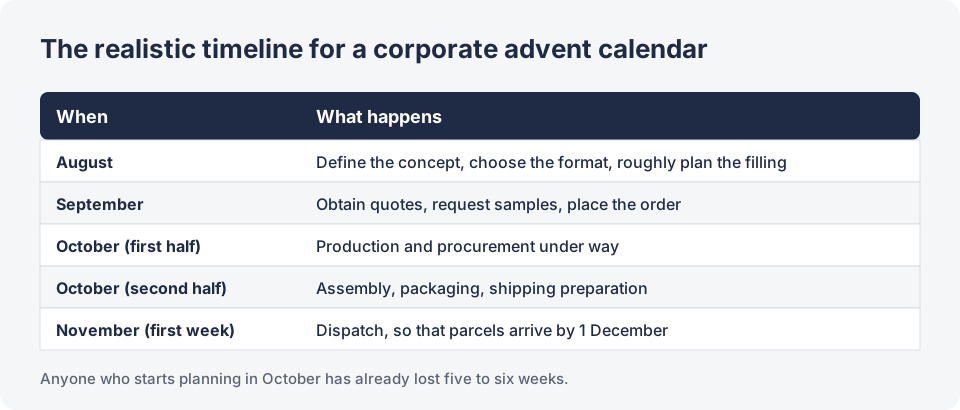
Advent calendars have the most complex production logistics of all Christmas gifts. The reason: contents, calendars and assembly have to be coordinated, often across different suppliers. The realistic timeline:
- August: define the concept, choose the format, roughly plan the filling
- September: obtain quotes, request samples, place the order
- October (first half): production and procurement under way
- October (second half): assembly, packaging, shipping preparation
- November (first week): dispatch, so that parcels arrive by 1 December
Anyone who starts planning in October has already lost five to six weeks. Customised contents (your own items, special productions) are then hardly feasible any more.
Our View: When Yes, When No
The corporate advent calendar is an excellent instrument – but not a universal one. Our clear assessment:
Recommended: For employees in companies that want to shape their company culture deliberately. For selected close customer relationships with a genuine personal connection. For companies that have the necessary budget and lead time to do it really well.
Not recommended: As a mass mailing to broad customer lists without a personal connection. For companies that start planning in October. As a cost-cutting measure with off-the-shelf goods – that does more harm than good. And not as a substitute for the Christmas gift if the actual aim is a personal present.
If you are seriously planning a corporate advent calendar – for whichever target group – we are happy to talk through the concept with you. Full service from product selection to shipping is our everyday business. And if you want to know how the logistics work for 50 or 500 units: our fulfilment department handles assembly, storage and shipping on your behalf.
Order directly: If you don't need an individually filled calendar but a ready-made solution for the Christmas season, you can find it under promotional products for autumn and winter.
Looking for full-service merchandising?
We handle your promotional product projects from A to Z – from a single source.
To Full-Service