

Guide
Promotional Items for Trade Show Stands: What Really Lasts – and What Goes Straight in the Bin
At trade shows, more money is wasted on promotional items than in almost any other context. The underlying problem: quantity beats quality. This article explains why that is a mistake – and how to plan trade show promotional items that actually have an impact.

Imagine the following scenario: a company invests 60,000 euros in a trade show stand. Professional architecture, high-quality displays, trained staff. The budget for promotional items: 2,000 euros for 1,000 pens, 500 cheap tote bags and a few chocolate bars with a logo print. After the show, the pen has run dry within three days, the bag has resurfaced on the next shopping trip and been given away, and the chocolate has been eaten – without anyone noticing the company name again.
This scenario is not an isolated case. It is the norm. And the reason is a fundamental error in thinking: the belief that the number of promotional items determines their impact.
The fundamental misconception about trade show giveaways
The usual logic goes: many items mean many contacts. That is true – but they are the wrong contacts. A pen that travels home in a trade show bag and ends up somewhere in a drawer is not an advertising contact. It is a statistical unit in the order quantity.
A promotional item has an impact when it is used. And it is used when it is good enough to be kept. That is the only relevant question when choosing trade show promotional items: would this object pass the "desk test" – that is, end up on a desk or in daily use rather than in the bin or a drawer?
Anyone who answers this question honestly has to say "no" for many standard items.
Two categories that should be kept strictly separate
Trade show promotional items have two completely different functions. If you do not separate them, you buy the wrong thing for the wrong purpose.
Category 1: the attention-getter – drawing visitors to the stand
This category is not about long-term brand presence but about immediate attention. The aim is to get people to stop at the stand or come over. Completely different means are suitable for this than for a lasting promotional item.
Classic attention-getters: high-quality snacks or drinks (barista coffee, special chocolate, regional specialities). Live demos that make passers-by stop. Prize draws with a visible mechanism. Or simply: an object that looks so unusual or valuable that it attracts people.
The attention-getter does not need to be tied to a brand name – it needs to steer the flow of visitors in your direction. What happens next is the job of the conversation and the leave-behind.
Category 2: the leave-behind – what works after the show
This is the actual promotional item. The object that outlives the trade show stand, that reminds the recipient of the conversation, that carries your brand into their daily routine. This object has to pass the desk test.
Strict criteria apply to the leave-behind: it must have genuine practical value. It must be of a quality that exceeds expectations. It does not need to be intended for every visitor – but for the people you have actually spoken to.
This is the most important point about the leave-behind: selective distribution. Not every passer-by who takes a bag is a qualified contact. The high-quality promotional item should only go to people with whom a real conversation has taken place. That reduces the quantity – and increases the impact dramatically.
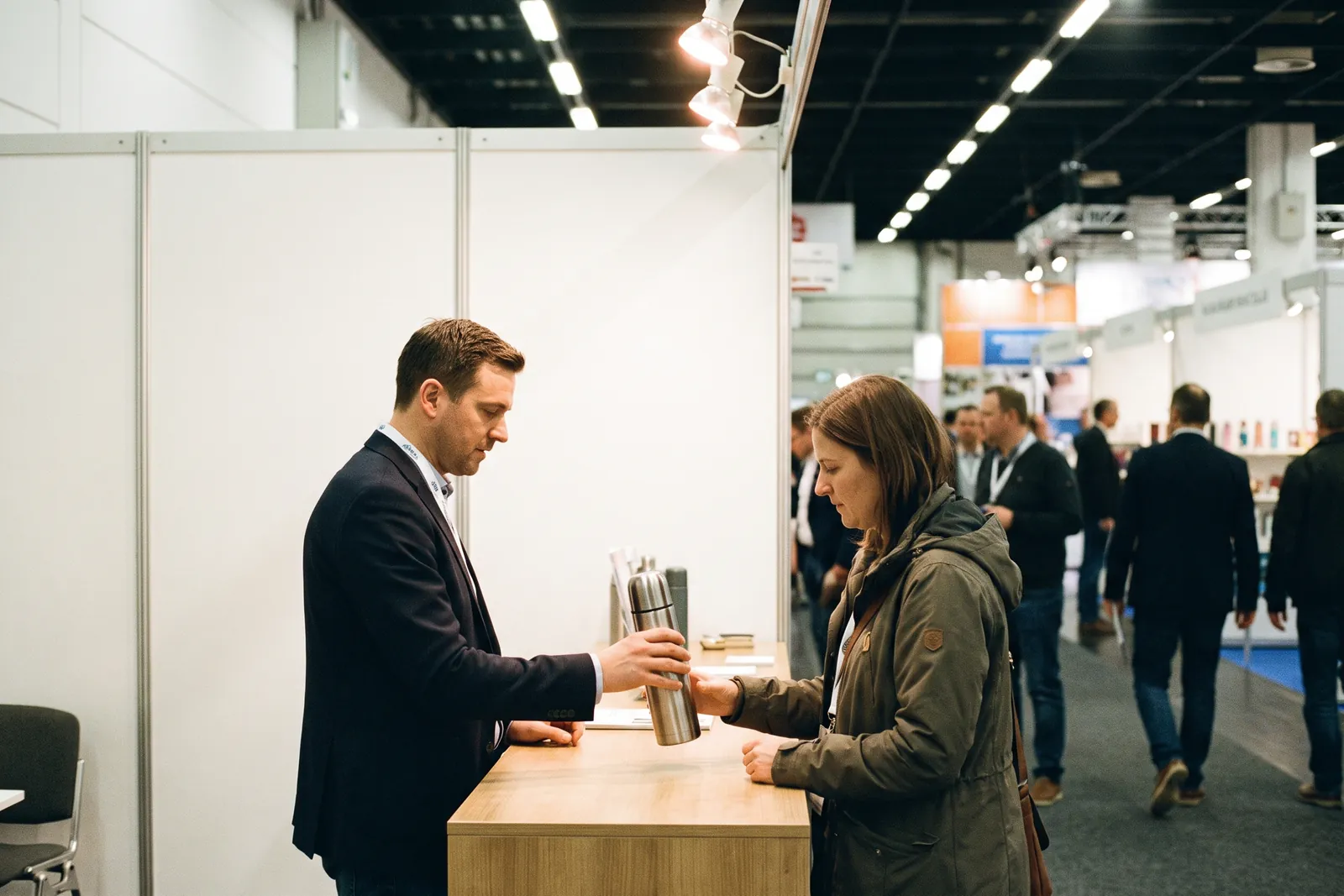
What really stays in the memory
Many conversations with companies after trade show appearances reveal a clear pattern: objects with everyday practical value and noticeable quality are remembered and kept. Objects that mainly show the logo are forgotten.
Proven as leave-behinds: High-quality vacuum flasks or insulated mugs (used daily, quality is immediately noticeable). Notebooks in a quality finish with a solid cover (part of everyday working life). Tote bags that look really good and are robust (taken along – and then used again). Charging cables or multi-function adapters for current devices (immediate practical value). Professionally relevant print products (studies, guides, industry-specific mini books) – rarely used, but highly memorable.
Regularly overrated: Pens as the only item. Key rings of any kind. USB sticks (often already outdated thanks to cloud infrastructure). Cheap tote bags that tear on the first shopping trip. Sweets with a logo – eaten, forgotten. Trade show badges and lanyard sets – which everyone has and nobody notices.
Audience matching: B2B trade fair vs. consumer show
The trade show situation differs fundamentally depending on the audience – and so does the right promotional item strategy.
At a B2B trade fair (industry fairs, buyer events, congresses), visitors are there in a professional capacity. They have a specific goal, assess stands by professional criteria and have little patience for distractions. The right leave-behind here: high-quality, functional, discreet in its branding. Professional relevance beats creative playfulness. A high-quality pen or a vacuum flask has more impact than a gadget that would go down well at a consumer show.
At a consumer show (public fairs, city festivals, consumer markets), the dynamics are different. Visitors collect, compare and are focused on offers. Here the attention-getter is more important than the leave-behind. Quickly consumable or eye-catching items have their place. The leave-behind should still be selective – only for people who have shown genuine interest.
Quantity planning: how many do you really need?
The most common misconception: "We expected 500 visitors, so we need 500 items." That is not true – and it leads to systematic over-ordering.
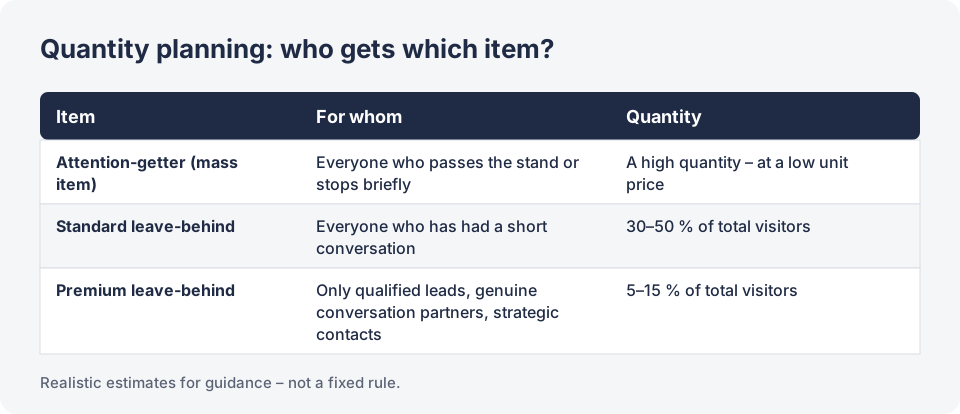
Realistic quantity planning is based on the distinction between qualified contacts and passing traffic:
- Attention-getter (mass item): For everyone who passes the stand or stops briefly. A high quantity is right here – at a low unit price.
- Standard leave-behind: For everyone who has had a short conversation. Realistic estimate: 30–50 % of total visitors.
- Premium leave-behind: Only for qualified leads, genuine conversation partners, strategic contacts. Realistic estimate: 5–15 % of total visitors.
Planning according to this logic means ordering significantly less – and spending more per item. The result is a higher return on investment, because the budget is concentrated on the contacts that really matter.
The tote bag: the underrated multi-purpose promotional item
At trade shows, the tote bag is one of the oldest promotional items – and one of the most underrated. Not because of its design but because of its function: anyone who has a good tote bag at a trade show carries it until the end of the day. And afterwards.
A high-quality jute or canvas bag that looks good and has sturdy handles is welcomed as practical at the show. After the show it continues to be used as a shopping bag or everyday companion. It is seen by other people. That is passive outdoor advertising that no other trade show promotional item in this price range achieves.
The opposite: a cheap non-woven bag that tears on the first shopping trip or becomes limp and unsightly after one use damages the brand. Invest in quality and you get a promotional item. Invest in quantity and you get rubbish with a logo.

Concrete options – without greenwashing
Trade show promotional items made from certified materials have a double advantage: they have real substance and set your brand apart from competitors' cheap standard items. The important thing is to stay specific and avoid blanket promises.
What is specifically possible: tote bags made from certified organic cotton (GOTS label, verifiable). Textiles made from rPET (recycled PET bottles, verifiable via certificate). Notebooks with FSC-certified paper. Stainless steel insulated mugs with a reusability message (which is true – stainless steel lasts for years).
What to avoid: vague claims such as "environmentally friendly" or "sustainable" without proof. Single-use items made from bamboo that are advertised across the board as "natural" (bamboo-plastic composites are more complicated than their marketing suggests). And products whose only "sustainability" argument is their green colour.
Timing and lead times
Trade show promotional items have a hard deadline: the show starts at a fixed time. Whatever has not been produced and delivered by then does not exist. That sounds trivial, but it regularly causes problems when the order is placed too late.
Realistic lead times: standard items without custom printing: 1–2 weeks. Items with custom printing or embroidery: 3–5 weeks. Custom productions (in-house developments, unusual items): 6–10 weeks. For international production (Asia): 10–16 weeks plus sea freight time.
If you are planning an important trade show in September, you should have finished ordering by July at the latest. For premium items with long production times: May/June. Anything ordered after August will be standard – and therefore not distinctive.
Our view: less is more, and that is not a cliché
The most honest assessment after many trade show projects: the volume of promotional items at trade shows is too high and the quality too low – almost everywhere. The reason is not ignorance but an incentive problem: focusing on quantity feels safer. Ordering 1,000 items looks like planning competence. Ordering 200 premium items requires the conviction that quality can replace quantity.
Our recommendation: set a clear budget and split it into two categories. A small budget for an inexpensive attention-getter (volume is fine here). A larger budget for a high-quality leave-behind in limited numbers, distributed selectively. The result: greater recall, less waste, higher return on investment.
If you are looking for concrete products and concepts for your next trade show, we would be happy to talk it through. Full-service consulting from product selection to delivery at the trade show stand – that is our everyday business. And if you would like to read more about strategic approaches to giveaways: our article on trade show giveaways that stay in the memory looks at the psychology of remembering. For finishing options on textiles, textile printing and embroidery explains the relevant methods.
Important distinction: This article considers the trade show stand as part of a larger merchandising programme. If you only need to equip a single trade show, see the trade show and event selection on unicum-werbeartikel.de (in German).
Looking for full-service merchandising?
We handle your promotional product projects from A to Z – from a single source.
To Full-Service