

Guide
Kitting: How Individual Items Become a Finished Merchandise Set – Process, Costs, Pitfalls
Welcome box, first-semester pack, event set: in kitting, several items are assembled into a finished set and shipped as a single consignment. This guide explains how it works, how the price per box is made up and where kitting projects fail in practice.

A hoodie, a drinking bottle, a notebook, a pen and a greeting card – individually, these are five promotional items. Neatly assembled in a box, with the recipient's name on the card and delivered on time for her first working day, they become an experience. The step in between is called kitting.
Kitting sounds like logistics jargon, but it is relevant for every company that uses merchandise not as mass-produced goods but as a well-thought-out package. This article explains exactly what kitting is, how a project runs, how the price is made up and which mistakes you should avoid.
What is kitting?
Kitting means: several items are assembled into a finished set and shipped as a single consignment. The set – known in the trade as a "kit" – has fixed contents, defined packaging and clear packing instructions. Every box looks the same; only personalised elements such as name or size differ.
Classic examples:
- Welcome boxes for new employees – for the first working day or sent home beforehand (onboarding box)
- First-semester packs with bag, calendar, pen and information material for universities (first-semester bags)
- Event sets for conferences, hybrid events or participants joining remotely
- Anniversary and thank-you packs for staff, clients or partners
- Sales and trade show kits for the field sales team: presentation material, giveaways, samples
- Influencer and press kits for a product launch or rebranding
Kitting, order assembly, fulfilment – what is the difference?
The terms are often used interchangeably. A practical distinction:
- Order assembly (in German: Konfektionierung) is the umbrella term for preparing goods for shipping – from repacking and labelling to assembling.
- Kitting is a specific form of it: bundling several different items into a set with fixed contents.
- Fulfilment covers the entire chain: storage, order intake, picking, packing, shipping and returns. Kitting can be one component of it.
How is kitting charged?
Kitting is usually charged as a price per box. For you as the client, that is easy to calculate. Behind it is a calculation made up of four components:
- Number of items × pick price: Every item that is taken from the warehouse or the stack and placed in the box is a "pick". Five items mean five picks.
- Packing time: Erecting the box, adding filling material, arranging the items attractively, inserting the card, closing the box, applying the shipping label. 3 to 6 minutes per box is realistic – depending on the number of items and the presentation standard.
- Packaging material: Box, filling material, tissue paper, sleeve and greeting card.
- Personalisation, if required: name on the card, on the textile or engraved on the bottle.
On top of this – usually shown separately – come shipping per consignment and, where applicable, storage costs if the boxes are not shipped all at once but on demand.
Example calculation
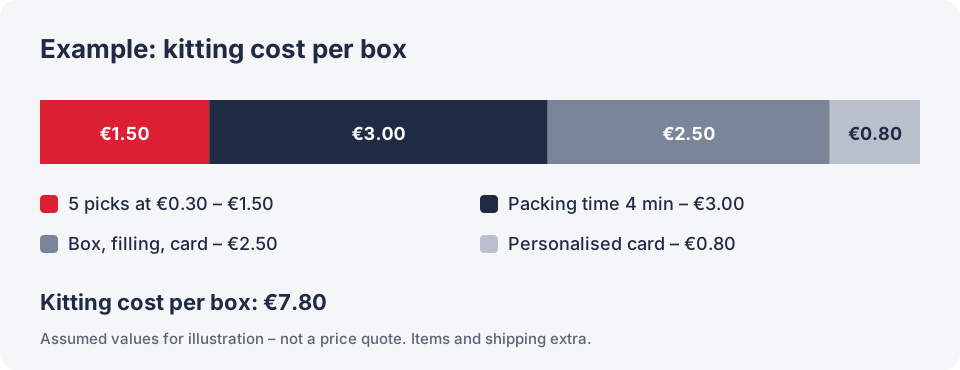
For illustration, a calculation with assumed values (not a price quote – actual rates depend on the project):
- 5 items × €0.30 pick price = €1.50
- 4 minutes of packing time at an assumed hourly rate of €45 = €3.00
- Box, filling material, card = €2.50
- Personalised card (printing + matching) = €0.80
This comes to around €7.80 kitting costs per box – plus the items themselves and shipping. As you can see, packing time is often the largest single item. Every minute by which a box can be packed faster saves more than eight working hours across 500 boxes.
How a kitting project runs
1. Define the contents and bill of materials
It all starts with the bill of materials: which items go in the box, in which version, with which branding? The question of variants is already important here. A hoodie comes in sizes, a bottle perhaps in two colours. Every variant increases complexity – and with it the risk of errors.
2. Define the packaging and packing layout
Decide whether the box itself is the shipping packaging or whether a high-quality presentation box is shipped inside an outer carton. A printed mailer box makes a strong impression when opened, but is exposed to scratches and stickers in transit. A packing layout – a photo or sketch of the fully packed box – is the most important work instruction for the packing team.
3. Goods receipt and quality inspection
All items arrive at the kitting location. There, quantity and quality are checked before packing begins. If an item is missing or a batch arrives faulty, the whole project comes to a halt. That is why all components should arrive with a buffer before the packing date.
4. Prepare the personalisation
Personalised elements need a clean data basis: names, sizes, delivery addresses. Ideally in a single list with a unique ID per recipient. For employee data: the service provider processes personal data on your behalf – this requires a data processing agreement under the GDPR.
5. Packing
Packing is done on a line or at packing stations, following the packing layout and pick list. With personalised boxes, matching is the critical step: the card for "Anna Müller" must go into the box with the size M hoodie and the shipping label for Hamburg. A proven approach is to pick all personalised elements for a box together before they go into the carton.
6. Shipping – all at once or on demand
With event sets or first-semester packs, all boxes go out at once – to one location or to many individual addresses. With welcome boxes, on the other hand, demand is spread across the year. In that case a warehousing model pays off: the boxes are pre-assembled, stored and shipped individually for each new hire. We explain which model fits better in our article on-demand vs. stock production.
The most common kitting mistakes
- Asking for sizes too late: A hoodie in the wrong size makes even the nicest box worthless. Sizes should be collected before the textiles are ordered – or you choose items that do not depend on size.
- Too many variants: Three box variants with four sizes each result in twelve different kits. Every variant costs time and increases the risk of errors.
- Box dimensions not checked: The bottle only fits at an angle, the hoodie has to be squashed in. A physical sample before series production of the boxes prevents this.
- Shipping weight and girth ignored: A few centimetres or grams can decide the parcel class – and therefore the shipping costs.
- Components arrive at different times: The packing team waits while the delivery date draws closer. Only schedule the packing date once all parts have confirmed delivery dates.
- Incomplete address data: Missing house numbers or PO boxes with parcel carriers lead to returned shipments. Checking addresses before shipping saves trouble.
How to reduce the cost per box
- Fewer but better items: Five high-quality items make a stronger impression than eight average ones – and save three picks.
- Pack-friendly design: Inserts or inlays into which every item fits exactly speed up packing and ensure a consistent look.
- Bundle personalisation: A name on the card is matched more quickly than a name on the card, textile and bottle.
- Plan batch sizes: Larger packing runs are more efficient than many small ones. For welcome boxes, it pays to pre-assemble a quarter's requirements.
- Components from a single source: When items, finishing and kitting come from the same partner, interfaces, transport between suppliers and rounds of coordination are eliminated.

From practice
Kitting does not always have to mean an elaborate presentation box. In a library bag project, we did not simply deliver 11,694 bags to a loading ramp but handed them over pre-picked in boxes of 80 – so they could be distributed directly to the individual issuing points without repacking. That is kitting too: preparing the goods so that no additional work step is required at the recipient's end.
Checklist for your kitting project
- Contents and bill of materials finalised
- Variants (sizes, colours) defined and requirements collected
- Packaging sampled: do all items fit, is the weight right?
- Packing layout created
- Personalisation data in one list with a unique ID
- Data processing agreement in place for personal data
- Delivery dates for all components with a buffer before the packing date
- Shipping model decided: one-off, staggered or on demand from the warehouse
- Addresses checked
Frequently asked questions about kitting
From how many boxes is kitting by a service provider worthwhile?
As soon as packing noticeably ties up working time internally – often from just a few dozen boxes. At the latest when boxes are personalised or go to individual addresses, packing layout, matching and shipping handled by a specialist partner are usually more reliable than a packing session in the office.
How long does a kitting project take?
The packing itself is usually the smallest part. What matters is the lead time of the components: individually finished items and printed boxes generally need several weeks. Plan backwards from the desired delivery date.
Can boxes also be shipped internationally?
Yes. For shipments outside the EU, customs formalities are added, and some items (such as batteries in power banks) are subject to special shipping regulations. This should already be taken into account when choosing the contents.
What is the difference between a welcome box and an employee store?
A welcome box is a fixed set that is sent for a specific occasion. An employee store lets employees choose from a range themselves. The two can be combined: for example, a welcome box with a voucher code for the store.
Our assessment
Kitting determines whether merchandise arrives as a collection of individual items or as a well-thought-out brand experience. The price per box is easy to calculate – provided the bill of materials, variants and packaging are fixed early. Most problems do not arise during packing but before it: sizes requested too late, unsuitable boxes or components that do not arrive on time.
If you are planning a welcome box, an event set or a first-semester pack, we take care of everything from item selection and finishing to shipping – as part of our logistics and fulfilment services. You will find ideas for the contents in our article on the welcome pack for new employees.
Looking for full-service merchandising?
We handle your promotional product projects from A to Z – from a single source.
To Full-Service